How to Produce Rubber Gloves: A Comprehensive Guide
Table of Contents
Introduction to Rubber Glove Production
Rubber gloves are essential personal protective equipment used across healthcare, food processing, industrial, and household sectors worldwide. The production of high-quality rubber gloves requires precise manufacturing processes, advanced machinery, and strict quality control measures. Understanding how rubber gloves are produced can help businesses make informed decisions about procurement and quality expectations.
The rubber glove manufacturing industry has evolved significantly over the past few decades, adopting automated processes and innovative technologies to meet increasing global demand. Whether for medical use, food handling, or general protection, the production process follows established standards and protocols to ensure safety and durability.
Raw Materials and Preparations
The foundation of quality rubber glove production begins with selecting appropriate raw materials. The primary material used is natural rubber or synthetic rubber latex, which serves as the base for the glove structure.
Key raw materials include:
Natural rubber latex is harvested from rubber trees and provides excellent elasticity and comfort. This material is often preferred for premium glove production due to its superior feel and flexibility. Synthetic latex, including nitrile and chloroprene, offers alternatives that may reduce allergic reactions and provide different protective properties for specific applications.
Chemical additives play a crucial role in the formulation process. These include vulcanizing agents like sulfur, accelerators that speed up the curing process, antioxidants that prevent degradation, and plasticizers that improve flexibility. Colorants may be added to create different glove varieties, such as blue, purple, or clear latex gloves.
Before production begins, raw latex must be carefully inspected and tested for consistency, viscosity, and purity. The material is stored in controlled temperature and humidity environments to maintain its properties and prevent premature degradation.
Rubber Compound Formulation
Creating the perfect rubber compound is both an art and a science. The formulation process involves mixing latex with various chemical additives in precise proportions to achieve desired properties such as strength, elasticity, and thickness.
The compounding process typically occurs in large industrial mixers where latex and chemical additives are combined gradually. Temperature control is critical during this phase to prevent premature vulcanization. The mixture must be homogeneous to ensure consistent glove quality throughout production.
Different formulations are used depending on the glove type. Medical-grade gloves require formulations that meet FDA and ISO standards, with careful attention to allergen content and barrier protection. Food-grade gloves need formulations compliant with FDA food contact regulations. Industrial gloves may include additional chemicals for enhanced resistance to oils, solvents, or punctures.
Once the compound is properly mixed, it undergoes testing to verify viscosity, gel time, and other critical parameters before moving to the dipping process. This quality checkpoint ensures that only properly formulated compound proceeds to production.
The Dipping Process
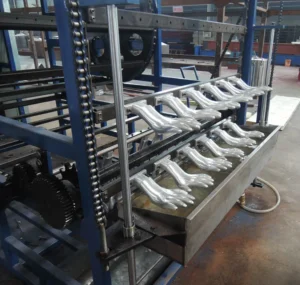
The dipping process is the core manufacturing technique for creating rubber gloves. This process involves repeatedly dipping ceramic or metal formers (hand-shaped molds) into the rubber compound to build up the glove wall thickness layer by layer.
The dipping process typically follows these steps:
First, ceramic formers are heated to optimal temperature, usually between 40-60°C. These heated formers are dipped into the prepared rubber compound, causing a thin layer of latex to coat the former. The former is then withdrawn from the compound at a controlled speed to ensure uniform coating.
After the initial dip, the former enters a coagulation zone where a chemical coagulant is applied. This causes the latex to set and adhere to the former, forming a tacky rubber layer. The coagulated layer enhances adhesion for subsequent dips.
Multiple dipping cycles are repeated to build the desired glove thickness. Typically, 3-5 dips are performed to achieve appropriate wall thickness of 0.10-0.15mm. Each dip adds a microscopic layer that contributes to the glove’s strength and puncture resistance.
Between dips, the formers may be cooled or maintained at specific temperatures to facilitate proper layer bonding. The spacing and timing between dips are carefully controlled to optimize glove properties.
Vulcanization and Curing
After the final dip, the dipped formers must undergo vulcanization, a chemical process that transforms the liquid latex into solid rubber. Vulcanization creates cross-links between polymer chains, giving the glove its elasticity, strength, and durability.
The vulcanization process typically occurs in a hot air oven or steam chamber heated to 80-140°C, depending on the rubber compound formulation and desired final properties. The time in the vulceration chamber ranges from 1-5 minutes.
During vulcanization, sulfur (or alternative vulcanizing agents in synthetic latex) chemically bonds with the rubber polymer chains. This process improves tensile strength, tear resistance, and elastic recovery. The glove becomes elastic and gains the ability to return to its original shape after stretching.
Proper vulcanization is critical for glove quality. Under-vulcanization results in weak, sticky gloves prone to tearing. Over-vulcanization can cause brittleness and cracking. Manufacturing facilities closely monitor temperature, humidity, and curing time to achieve optimal vulcanization.
Stripping and Finishing
Once vulcanization is complete, the cured rubber gloves must be removed from the ceramic formers. This process, called stripping, is typically performed by mechanical equipment or skilled workers who carefully roll the glove edge downward to separate it from the former.
After stripping, the gloves enter the finishing stage where several important processes occur. Any excess latex at the cuff is trimmed to create a neat, uniform edge. Some manufacturers add a light coat of powder to prevent the gloves from sticking together.
In modern facilities, gloves are often leached in water tanks to reduce allergen content and residual chemical levels. This process is particularly important for medical-grade gloves intended for sensitive applications or for individuals with latex sensitivity.
The gloves then move through drying chambers where moisture is removed at controlled temperatures and humidity levels. Proper drying prevents mold growth and ensures gloves are ready for packaging. Final inspection occurs at multiple points during this stage to identify and remove any defective gloves.
Quality Control and Testing
Quality control is paramount in rubber glove manufacturing. Comprehensive testing ensures that gloves meet regulatory standards and customer expectations for safety and performance.
Key quality tests include:
Tensile strength testing measures the force required to tear a glove, ensuring it meets minimum standards typically set by ISO 23644 or similar international regulations. Elongation testing determines how much a glove can stretch before breaking.
Pinhole detection equipment uses high-voltage electricity to identify microscopic punctures or weak spots in gloves. This is critical for medical and food-contact applications where any defect could compromise protection.
Water leak tests involve filling gloves with water under pressure to detect permeability issues. Gloves used in healthcare settings must maintain their barrier integrity to provide adequate protection against bloodborne pathogens.
Thickness measurements ensure consistency across all gloves produced. Sampling protocols involve random selection of gloves throughout production runs for comprehensive testing. Package integrity is verified to ensure gloves remain sterile or protected until use.
Chemical residue testing measures levels of accelerators, heavy metals, and other chemicals to ensure they fall within acceptable limits for intended use. Allergen testing is particularly important for latex gloves to ensure protein levels are acceptably low.
Packaging and Distribution
The final stage of rubber glove production involves careful packaging to preserve glove quality and protect them until use. Proper packaging prevents contamination, maintains sterility where required, and facilitates safe handling and storage.
Individual gloves are typically packaged in sealed bags or boxes containing specific quantities, such as 100 or 1000 gloves per box. Medical-grade gloves often require sterile packaging with appropriate labels indicating sterilization method, expiration date, and regulatory certifications.
Packaging materials must be appropriate for the storage environment and intended use. Some gloves require protective coatings to prevent premature degradation during storage. Temperature and humidity-controlled storage facilities maintain glove integrity during the distribution chain.
Labeling includes important information such as size, material composition, intended use, expiration date, batch number for traceability, and relevant certifications such as FDA approval or CE marking for European markets.
Distribution channels vary based on the glove type and market. Medical gloves are typically distributed through healthcare suppliers, while food-grade gloves reach food service suppliers and industrial gloves are supplied to manufacturing facilities and distributors.
Conclusion and Call to Action
The production of quality rubber gloves involves a complex, multi-stage process requiring precision machinery, skilled expertise, and rigorous quality control. From raw material selection through final packaging, every step contributes to creating gloves that meet safety standards and performance requirements across diverse applications.
Understanding this manufacturing process helps procurementprofessionals evaluate suppliers and ensure they obtain gloves meeting their specific needs and regulatory requirements.
Looking for Reliable Rubber Glove Production Solutions?
We are professional rubber gloves machine manufacturers with years of industry expertise. We provide cutting-edge equipment, technical support, and comprehensive solutions for your glove production needs. Whether you’re establishing a new facility or upgrading existing equipment, our team is ready to assist you.
Contact us today to discuss your rubber glove production requirements and discover how our machinery can enhance your manufacturing efficiency and product quality.